
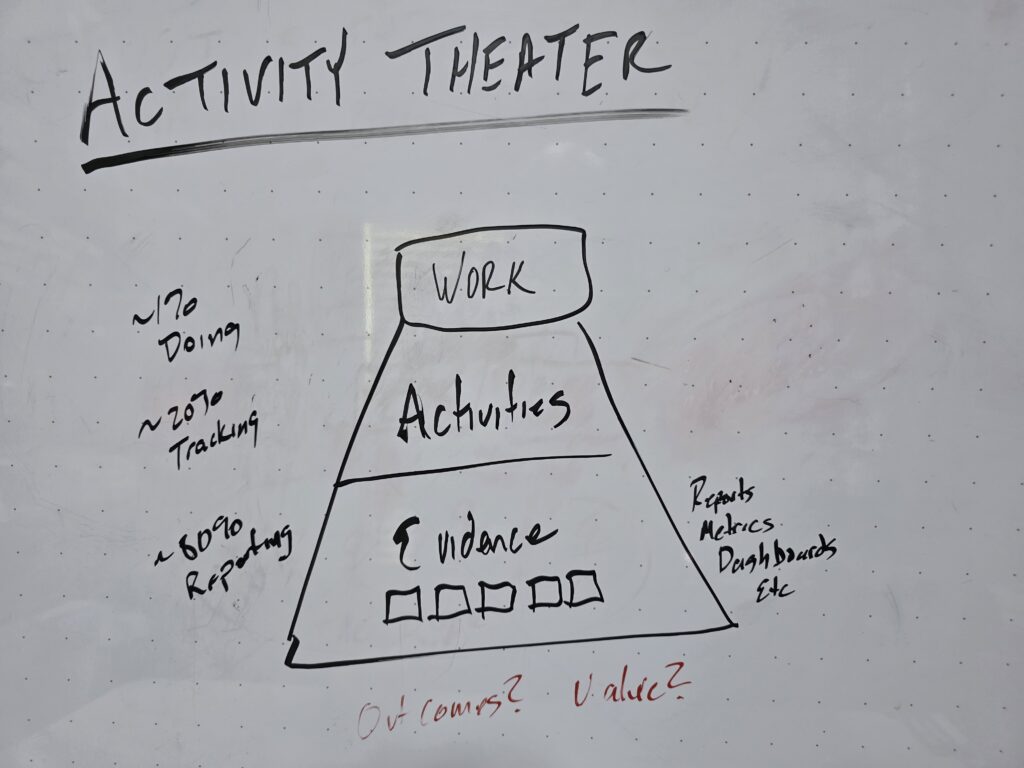
The biggest obstacle to delivering value isn’t a lack of work. It’s mistaking activity for progress.
One of the easiest traps for organizations to fall into is confusing evidence of work with evidence of value.
The distinction seems obvious, but it happens constantly. Teams close tickets, complete projects, produce documentation, and follow processes. Dashboards improve. Status reports look positive. Leaders have plenty of evidence that activity is happening.
The harder question is whether that activity created meaningful change.
A team that closes 1,200 tickets in a month appears more productive than a team that closes 600. The numbers are visible, comparable, and easy to communicate. But they do not tell us whether either team improved the customer experience, reduced risk, accelerated decisions, or created business value.
They tell us work happened.
They do not tell us whether the work mattered.
Organizations rarely set out to optimize activity over outcomes. The drift usually happens because outputs are easier to measure. They appear immediately, fit neatly into dashboards, and create a sense of control.
Outcomes are different. They often take time to appear. They require context and judgment. They are harder to attribute to a single team or activity.
That creates an uncomfortable reality: the things organizations can measure most easily are not always the things they value most.
I have seen this pattern when organizations attempt to create visibility by tracking every possible activity. Teams create tickets for development work, meetings, sprint activities, administrative tasks, and other operational work. The intent is understandable. Leaders want transparency. Teams want their contributions recognized.
The result is often a very detailed record of effort.
But effort is not the same as impact.
I experienced a similar challenge when I was asked to develop metrics for an architecture function at a previous organization. We could easily measure what architecture produced: roadmaps created, standards documented, patterns developed, designs reviewed, and projects supported.
All of those measures represented real work.
The problem was that they did not answer the questions leaders ultimately cared about.
Did architecture improve delivery? Did it reduce unnecessary complexity? Did it accelerate decisions? Did it reduce risk? Did it help the organization create more value?
We were measuring what architecture produced, not what architecture enabled.
This distinction exists across organizations. It is much easier to hold someone accountable for completing an activity than it is to measure the downstream impact of that activity. A document can be delivered. A meeting can be held. A process step can be completed.
Whether any of those changed the outcome is a harder conversation.
Over time, organizations naturally begin optimizing around what they can demonstrate. Metrics that were created to provide visibility begin influencing behavior. The measurement system slowly becomes the operating system.
The metric becomes the mission.
This is where activity theater begins. The organization becomes highly effective at producing evidence that work is happening while losing sight of whether the work is creating meaningful progress.
Process becomes more important than intent. Governance becomes more important than value. Compliance becomes more important than learning.
The solution is not to eliminate outputs. Organizations need outputs. Without them, work becomes invisible and leaders lose important signals.
The challenge is remembering what outputs are: evidence.
A useful question for any metric is simple:
What outcome is this output intended to influence?
If the metric doubled tomorrow, would customers notice? Would decisions improve? Would risk decrease? Would the organization be better positioned to achieve its goals?
If the answer is unclear, the organization may not have an execution problem.
It may have confused activity with progress.