
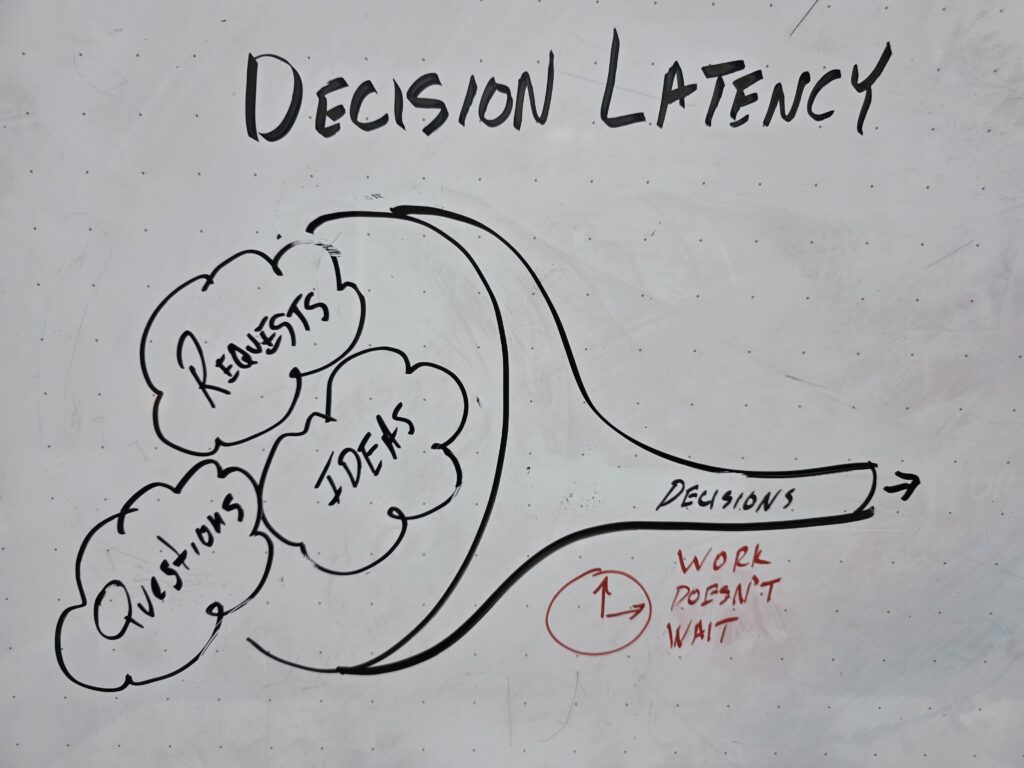
Decision latency creates output inflation without outcome progress.
Chances are you’ve experienced some version of this:
The project needs input from key stakeholders.

They're busy, the earliest they can meet is next Thursday.

Thursday arrives.

The agenda runs long.

Your item gets bumped.

Nothing is technically blocked ... except the work.
Organizations spend significant effort improving execution. They invest in project management practices, delivery methods, governance processes, documentation standards, reporting structures, and tools intended to help teams move faster and operate more effectively. Those investments are often valuable, but they tend to focus on how work is performed after direction has been established.
A less visible constraint exists earlier in the process: how quickly the organization can make decisions.
A project may have the right people, sufficient funding, and a capable delivery team, yet progress can still slow because a decision is unresolved. The team may need input from a business stakeholder, approval from a leadership group, clarification on priorities, or a decision between competing approaches. The delay may appear minor at first. A meeting is scheduled for the following week. The agenda runs longer than expected. The discussion is postponed.
No single event appears significant.
The cumulative impact is.
Decision latency is the time between when an organization needs a decision and when that decision is actually made. In complex organizations, that gap can create significant friction because work rarely remains perfectly still while waiting for direction. Teams continue planning, preparing options, making assumptions, and creating partial solutions based on incomplete information.
Over time, those decisions create hidden costs. Work may need to be revisited. Priorities may shift after effort has already been invested. Teams may spend additional time coordinating because ownership or direction remains unclear. The organization continues to appear active, but progress slows because the decisions required to move forward have not been resolved.
This pattern is often mistaken for an execution problem. A project misses a deadline, and the immediate question becomes whether the team delivered effectively. However, the underlying constraint may have occurred much earlier, when the team was waiting for clarity.
I have seen this repeatedly in technology initiatives. Teams are often capable of moving quickly once they understand the objective, the constraints, and the tradeoffs they are expected to make. The challenge is that those decisions are not always made at the point where they are needed.
Instead, decisions move upward through layers of review and discussion. Each additional step may have a reasonable purpose: reducing risk, ensuring alignment, or involving the right perspectives. The challenge comes when the organization creates more pathways for reviewing decisions than for making them.
Good governance should improve decision quality. It should clarify who decides, what information is needed, and what tradeoffs are acceptable. When governance becomes primarily focused on additional review and approval, it can unintentionally slow the very outcomes it was intended to support.
The question leaders should consider is whether their operating model creates clarity at the speed the organization requires.
Which decisions consistently take longer than they should?
Are those delays caused by complexity, or by unclear ownership?
Which approvals provide meaningful confidence, and which exist primarily because removing them feels uncomfortable?
What work is currently waiting for a decision?
These questions are important because delay has a cost even when it is not visible on a financial statement or project dashboard. Teams spend time preparing alternatives that may never be needed. They schedule meetings to compensate for uncertainty. They create additional documentation because the decision path is unclear.
The organization pays for the delay through slower delivery, reduced focus, and diminished confidence.
Improving execution remains important, but execution can only move as quickly as the decisions that enable it. Organizations that want to increase their ability to deliver should examine not only how work is performed, but also how decisions are made, who owns them, and whether the current process supports timely judgment.
The speed of an organization is often determined long before work reaches the delivery team.
It is determined by the decisions that allow the work to begin.