
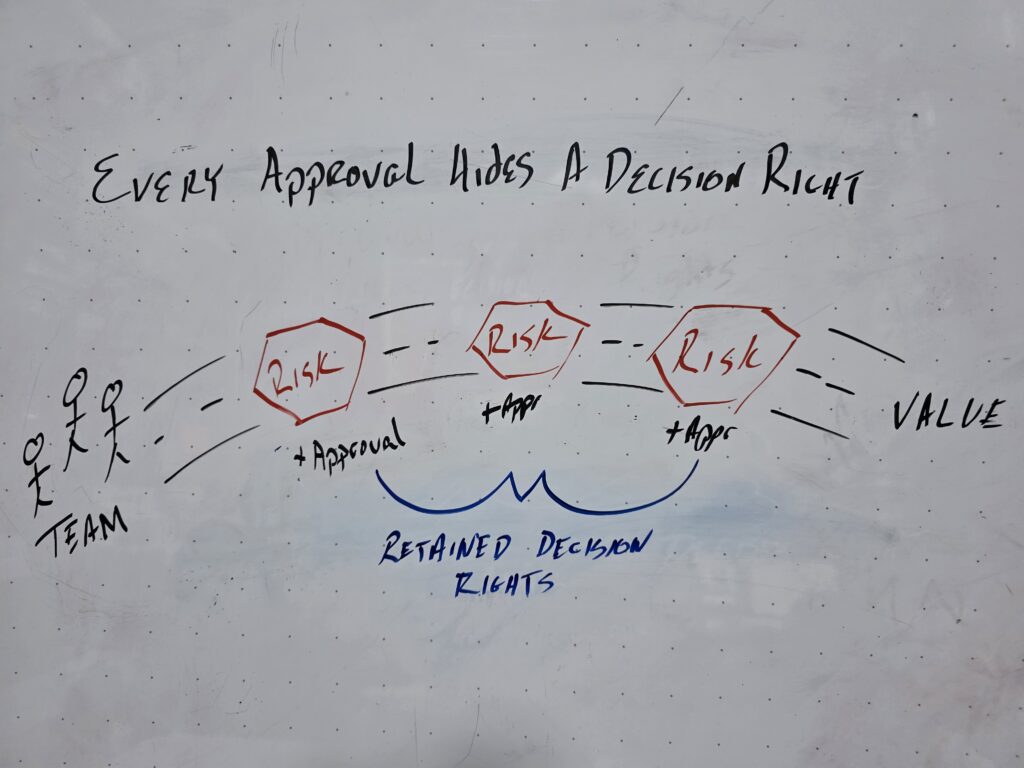
Most organizations think of approvals as process steps. A request is submitted, reviewed, approved, and the work moves forward. When projects slow down, the conversation usually focuses on reducing bottlenecks or making the approval process more efficient. In my experience, that misses the more important question: Is this approval even needed anymore? The approval isn’t hidden. Everyone can see it. What often goes unnoticed is the decision right behind it; the organizational choice that says this decision still belongs to someone else.
Approvals are not simply administrative activities. They are organizational design decisions. Every approval reflects an organizational choice to retain that decision right somewhere else. Sometimes that is exactly the right choice. Sometimes it is not. Complexity begins to grow when those decision rights accumulate over time without anyone revisiting why they were retained in the first place.
Not every approval is unnecessary. Early in my career, I was the architect for a strategic initiative where the development team wanted to connect a new application directly to the billing system. I rejected the design and required them to introduce an abstraction layer between the two systems. The team disagreed. After several days of discussion, I discovered they had already built the direct integration. My decision required roughly two weeks of rework.
At first glance, that sounds like architecture becoming an unnecessary bottleneck. It certainly created friction for the team. But the decision right belonged with architecture because the consequences extended well beyond the current project. A direct integration would have tightly coupled the two systems that we knew would evolve independently over time. The additional work protected future flexibility. The approval introduced short-term friction to avoid much greater long-term costs.
The question is not whether approvals create friction. They always do. The question is whether the value of retaining that decision right still exceeds the friction it introduces.
Every approval solves a problem that existed at the time. A security incident results in a security review. A costly project leads to additional financial oversight. A compliance issue introduces another governance checkpoint. Each new approval addresses a legitimate concern. Viewed individually, they often make perfect sense.
The difficulty is that organizations are much better at adding decision rights than removing them. Every new review feels like an incremental improvement. Very few leaders periodically ask whether the underlying risk still requires centralized authority. Complexity accumulates one reasonable decision at a time until the organization has far more approvals than anyone intentionally designed.
I saw this from the opposite perspective while working in an architecture organization that required every project to receive architecture approval before deploying to production. The process had existed for years. When a new Head of Architecture joined the organization, he asked a simple question: “What happens if we don’t sign off?” No one could give a clear answer.
Projects had been going to production successfully without architecture being consistently involved in many of them. The approval had become a routine checkpoint rather than a meaningful decision. It existed because it had always existed.
His response was equally simple. We stopped requiring the approval, and nothing broke.
Projects continued deploying as they had before, and the architecture team recovered capacity that could now be invested where architectural involvement genuinely reduced risk and improved outcomes. Removing the approval did not eliminate governance. It removed a retained decision right that no longer created value.
That experience reinforced something I have seen repeatedly over the years. Organizations rarely become complex because someone intended to create bureaucracy. Complexity usually emerges because old decisions are preserved while new ones are added. Decision rights are retained long after the conditions that justified them have changed.
The cost is not limited to longer approval queues. Every retained decision right moves authority further from the people with the most context. Teams begin optimizing for what will be approved instead of what best serves the intended outcome. Decisions wait for calendars instead of moving with the work. Friction becomes part of the operating model rather than the exception to it.
Instead of asking how to make routine decisions faster, try asking what decision is actually being retained. Ask why that decision is still better made there than by the people closest to the work. If no one can answer these questions, then approval may no longer serve its original intent.
An approval is not evidence that governance is effective. It is evidence that the organization has chosen to retain a decision right. That choice may still be correct. It may also be a piece of inherited complexity that no one has challenged in years. The next time a project waits for another signature, don’t start by asking how to speed up the process. Ask if the decision still belongs there at all. It may be that the organization has simply forgotten why it retained it.