
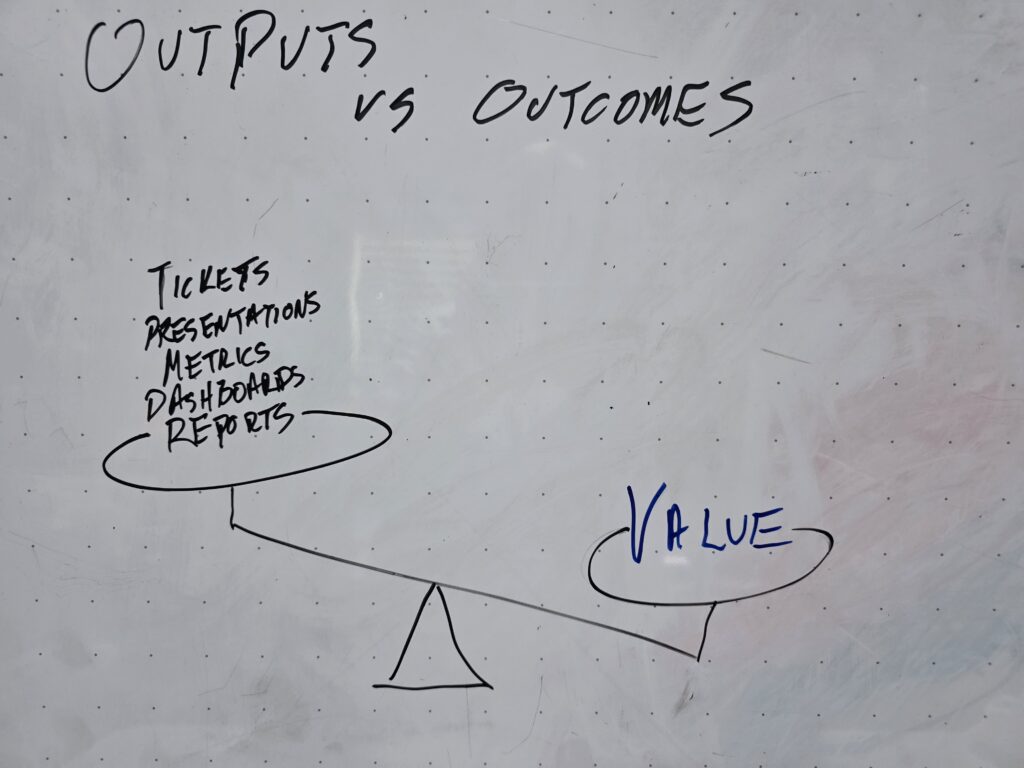
Outputs only matter when they change an outcome.
Most Organizations Do Not Struggle With Execution. They Struggle With What They Optimize For.
After more than 30 years working in technology leadership, I have noticed a recurring pattern across organizations of very different sizes and industries. Most organizations are not struggling because people are unwilling to work hard or because teams lack the ability to execute. In many cases, the opposite is true. People are delivering projects, solving problems, managing complexity, and adapting to constant change.
The challenge is that organizations can become very effective at producing evidence of work without always creating evidence of value. The difference between the two is subtle, but it influences how success is measured, how decisions are made, and how work gets prioritized.
Throughout my career, I have worked across construction estimating, financial services, government, military, hospitality, manufacturing, and technology organizations. I have worked with small teams and global enterprises. While the environments and challenges varied, the same patterns appeared repeatedly: outputs becoming the objective instead of the evidence, processes becoming more important than the outcomes they were created to support, and decisions slowing down as organizations attempted to manage increasing complexity.
These patterns rarely emerge because someone made a poor decision. More often, they are the result of reasonable decisions accumulating over time. A metric is added because leaders need better visibility. A process step is introduced because a previous issue needs to be prevented. An approval is added because risk needs to be managed. Each decision makes sense in isolation.
The challenge appears later, when the organization changes but the mechanisms remain.
One of the clearest examples is how organizations measure work. Outputs are necessary. They provide visibility, accountability, and evidence that activity is occurring. The problem begins when the output becomes the measure of success rather than a signal that helps determine whether progress is being made.
A completed project does not guarantee a customer problem was solved. A documented process does not automatically mean risk was reduced. A dashboard full of improving metrics does not ensure that the organization is creating more value.
The organization is highly capable in measuring what the team produced. It struggles when measuring what the organization gained. The work only matters because of what changes as a result.
The same pattern appears with process. Most processes begin with good intentions. They exist because someone identified a recurring problem and created a consistent approach to address it. At that point, the relationship is straightforward: the process exists to support the intent.
Over time, additional controls are often introduced. More reviews. More approvals. More documentation. Each addition usually addresses a legitimate concern. The problem is not that any single step is unreasonable. The problem is that the accumulated process can eventually become disconnected from the original purpose.
I experienced this firsthand when I spent several hours navigating a process designed to ensure time was recorded against the correct project. The intent was valid. Accurate reporting mattered. The unintended result was that a significant amount of productive time was spent managing the process rather than completing more work.
This same dynamic appears in decision-making. When organizations face uncertainty, they often respond by adding more control: additional approvals, more governance reviews, and more reporting requirements. These responses are understandable. Leaders are trying to make responsible decisions and protect the organization.
The challenge is that every additional decision point introduces friction. Work waits for clarification. Teams make assumptions when priorities remain unclear. People create alternatives because they do not know which direction will ultimately be approved.
The organization remains busy, but momentum declines.
Over time, these patterns create a gap between activity and impact. The organization can appear productive while becoming less effective at creating meaningful change.
The goal is not to remove process, governance, or measurement. Complex organizations require structure. The challenge is ensuring that the structure continues to serve its purpose.
The questions that matter are often simple:
Are we measuring activity because it creates value, or because it is easier to measure than value?
Does this process help achieve the intended outcome, or have we started protecting the process itself?
Are we adding structure to create clarity, or adding structure because uncertainty is uncomfortable?
These questions have shaped how I evaluate organizations, technology decisions, and operating models. After decades of working in complex environments, the pattern I continue to see is that the most effective organizations are not necessarily the ones with the most processes, the most metrics, or the most controls.
They are the ones that remain clear about what they are trying to accomplish.
Outputs provide evidence that work occurred.
Outcomes determine whether the work mattered.