
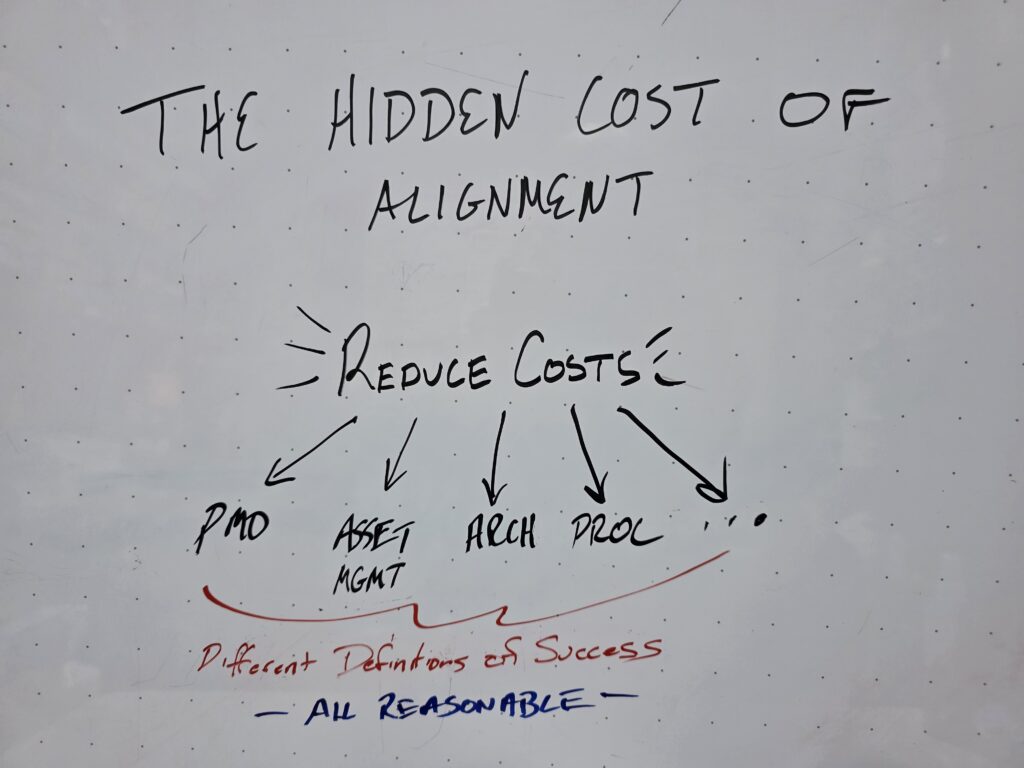
I’ve lost count of the number of meetings where everyone left believing they understood the objective, only to discover later that every team was working toward a different outcome.
There was no disagreement in the meeting. No one intentionally ignored the direction. Everyone believed that they were working toward the same goal and at some level they were. The problem was they each were solving a different version of success.
I’ve seen this happen multiple times, but one stands out above the rest. Leadership challenged the organization to optimize IT spending. The request is simple enough, and everyone quickly agreed it needed to happen.
The project management group developed new methods to more accurately track time. Asset management started identifying systems that could be retired. Architects identified overlapping capabilities that could be consolidated. Every team acted within their areas of responsibility. Every response was reasonable. The problem wasn’t that anyone misunderstood the request. Each team answered a different version of the request because each team viewed it through the responsibilities they already owned.
Looking back, I wouldn’t say that the organization lacked alignment. It lacked a shared definition of what success should look like. That distinction matters because of the way teams naturally optimize their work. Teams optimize based on the boundaries that they perceive. If those boundaries are different then intelligent people will make different decisions while believing that are faithfully executing the same objective.
There is a temptation to call this an execution problem because that is where the symptoms appear. Capacity becomes fragmented. Teams are working hard against competing priorities. Integration becomes more difficult than planned. And leadership is wondering why progress feels slower than anticipated.
In my experience, the root cause began much earlier and execution merely exposed it. Leadership communicated a direction, and the organization filled in the missing boundaries for itself. Once that happened the outcome was largely predictable. Not because people were making poor decisions, but because they were making good decisions against different definitions of success.
This isn’t the result of poor leadership. There are good reasons for leaving objectives broad; the strategy is still evolving, information cannot be shared, or maybe they are just looking for new ideas. Ambiguity has value during exploration because the different interpretations produce different possibilities. The problem begins when that discovery quietly becomes execution. If leaders are looking for ideas, then the broad approach is appropriate. Once execution starts, however, those same differences start generating competing solutions. Every team keeps working toward their own definition of success. The hidden cost isn’t confusion. It’s that the organization is spending scarce capacity interpreting intent instead of advancing it.
Years later, I observed the opposite happen during a large cloud migration. The objective was not overly explicit. Everyone aligned on the outcome, however, we spent time agreeing on what success meant. The driving factor was cost savings, but not at the expense of platform stability. We had opportunities to introduce much wanted new features, but we agreed that stability came first and features would follow. We negotiated trade offs to clarify future judgment calls.
There was a moment during the project that told me we had achieved something more valuable than simple alignment. The project manager asked a question that could have easily produced different answers from different teams. Without hesitation, someone replied that the decision maker was out of the office. The important part wasn’t knowing who owned the decision. It was that no one questioned where the decision belonged. The team had developed a shared operating model because they shared a single definition of success. This helped independent decisions to naturally converge toward the same outcome.
That experience changed how I think about clarity. Clarity is not detailed instructions, nor is it about eliminating ambiguity. Clarity is providing enough operational boundaries that independent decisions naturally converge toward the same outcome. When organizations skip that work, alignment becomes misleading. Agreement creates the impression that everyone understands the objective, while execution reveals that they each had a different definition of success.
The question I would ask is not does everyone agree with the strategy. It is to ask if the leaders of each area would make decisions that converge on the same definition of success.