Process without intent becomes performance theater.
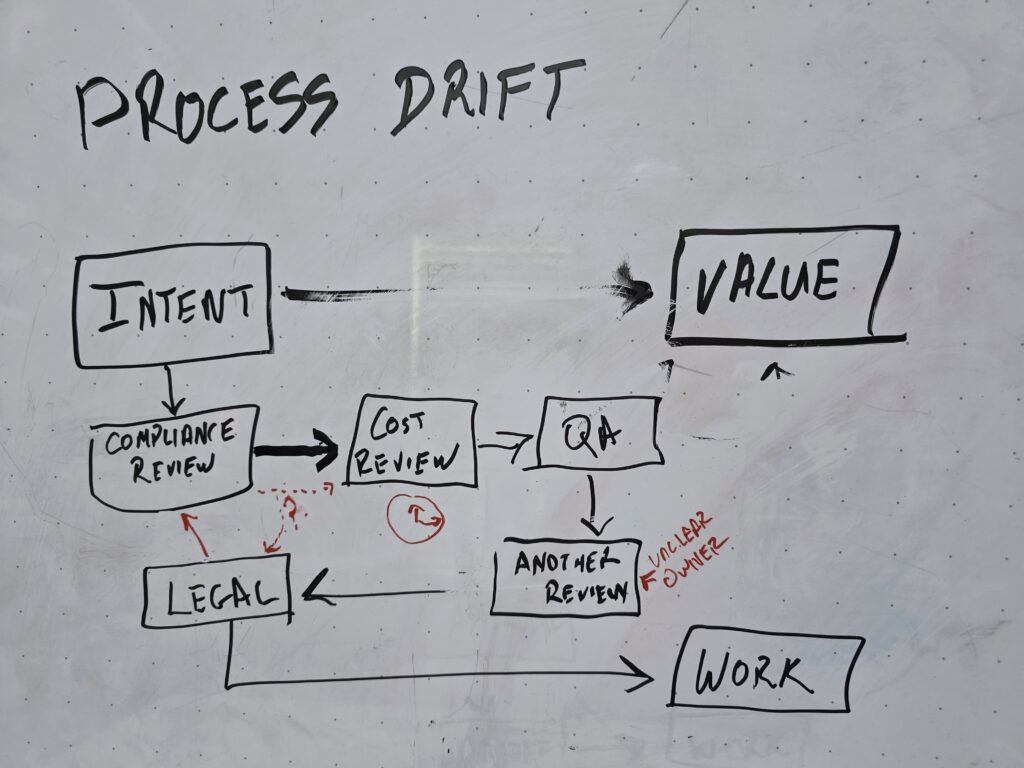
One of the more difficult organizational problems to identify is when a process has slowly moved away from the purpose it was created to serve. Unlike a system failure or a major operational breakdown, process drift rarely announces itself. Work continues, meetings happen, approvals occur, and dashboards remain positive. From the outside, everything appears operational. The problem is that the connection between the process and the outcome it was intended to support has gradually weakened.
Most processes begin with a legitimate purpose. They are created because an organization has encountered a real problem, a meaningful constraint, or a need to improve consistency. A governance process might exist to reduce risk. A review process might exist to improve decision quality. A standard might exist to prevent unnecessary variation. In the beginning, the relationship is straightforward: the process exists to enable a desired outcome.
Over time, however, organizations naturally modify the systems they rely on. A checkpoint is added because someone wants additional assurance. A report is introduced because leaders need more visibility. An approval step is added because a previous decision created risk. Each individual change is usually reasonable, and often necessary. The challenge is that organizations rarely step back and evaluate whether the accumulated changes still support the original intent.
Eventually, the process itself can become the thing being optimized. People begin focusing on whether work moved through the required steps rather than whether the process helped produce the intended result. The organization shifts from asking, “Did this help us achieve the outcome?” to asking, “Did we complete the required activities?”
That shift is subtle because the process may still be functioning exactly as designed. The issue is not that people are failing to follow the process. In many cases, they are following it extremely well. The issue is that the environment, constraints, or objectives have changed while the process has remained largely unchanged.
I have seen this pattern emerge in technology governance. In one organization, the original goal of a technology review process was reasonable: prevent unnecessary duplication, manage costs, and ensure new solutions aligned with existing capabilities. As the organization matured, additional controls were introduced to improve decision-making. A mandatory architecture review was added, an evaluation matrix was created, and meetings with subject matter experts became part of the approval process.
Each addition made sense when considered individually. The process became more thorough and more defensible. It also became significantly slower. Teams eventually began looking for shortcuts and workarounds because the process created more friction than value. Despite the additional governance, the organization still accumulated multiple overlapping reporting tools.
The process had become effective at demonstrating that decisions were reviewed. It was less effective at helping the organization make better decisions.
This is where process drift becomes dangerous. Organizations often begin trusting the process more than the judgment of the people operating within it. Repeatability, auditability, and consistency are valuable characteristics, especially in complex environments. However, those characteristics can create the illusion that a process is effective simply because it is being followed.
A process can be compliant and still fail to achieve its intent.
When this happens, organizations begin optimizing for the wrong outcomes. Compliance starts to matter more than clarity. Consistency starts to matter more than effectiveness. Control starts to matter more than informed decision-making. The organization is not intentionally choosing the wrong path; it is simply continuing to optimize the system it has created.
The most concerning aspect of process drift is not inefficiency. Inefficiency is usually visible. People recognize excessive meetings, slow approvals, and unnecessary documentation. The more difficult problem is that process drift can allow organizations to remain busy while gradually losing connection to meaningful outcomes.
Work continues. Outputs increase. Activity remains high. But the relationship between effort and value becomes increasingly difficult to see.
The solution is not to eliminate process. Complex organizations need structure. They need standards, governance, and repeatable approaches for managing risk. The challenge is ensuring those mechanisms continue to serve the purpose they were created to support.
Every process should periodically answer a simple question: What intent does this serve today?
Not when it was created. Not when it was last reviewed. Today.
Organizations change. Markets change. Strategies change. Technology changes. A process that was valuable under one set of conditions may become unnecessary or counterproductive under another.
The presence of a process is not evidence that it creates value. It is evidence that, at some point, someone believed the process served an important purpose.
The responsibility of leaders is ensuring that purpose still exists.